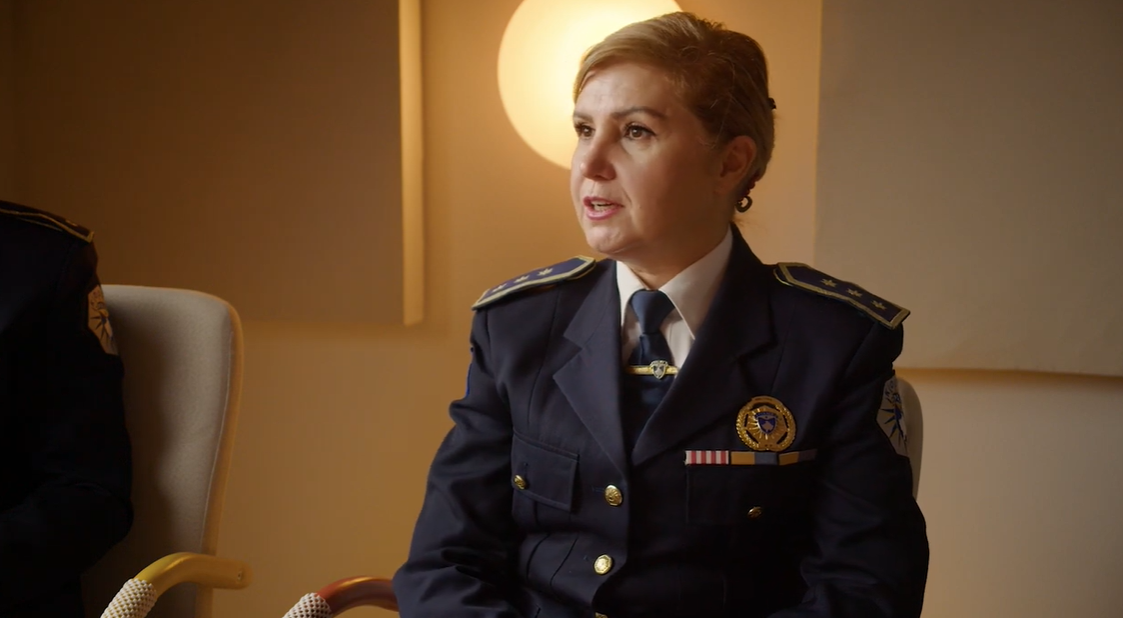

In 1999, when Kosovo began taking its first steps toward building security institutions, a new generation of women responded to the call to serve the country. Among them was Colonel Afërdita Mikullovci, part of the very first generation of the Kosovo Police. Her career has been marked by historic milestones: from her participation in establishing the first police force, to becoming the first woman appointed as Regional Police Director in South Mitrovica, where she led hundreds of officers in one of the country’s most sensitive regions.
For Colonel Mikullovci, the police uniform is more than a duty. It is, as she herself describes, a noble and sacred profession. Her journey reflects resilience in the face of post-war challenges, unwavering dedication to citizens, and a vision for a more inclusive security sector.
Through this interview conducted by the Institute for Women, Peace, and Security, Colonel Mikullovci invites us to reflect on the role of women in the security sector and on the paths Kosovo must take to make the Women, Peace, and Security (WPS) agenda a real part of everyday life.
________________________________________________________________________
You were part of the first generation of women to join the Kosovo Police in 1999, at a time when the country was just building its first security institutions and infrastructure was minimal. Later, you became the first woman to lead a Regional Police Directorate, commanding hundreds of officers in South Mitrovica. How was it for you to not only be part of this historic journey, but also to represent a new vision for women’s inclusion in policing and security more broadly?
You rightly call it a historic journey, because that is what it truly is. The very fact and fate of being employed in the Kosovo Police as part of the first generation is itself history, a living part of a contemporary story. My employment date, September 6, is Kosovo Police Day, and every anniversary and celebration of the Kosovo Police is therefore a double celebration for me. Every year I live it with special emotion and excitement, even if it may sound like a simple refrain. In truth, it is a feeling that cannot be described, what weight and meaning the police uniform and our noble, sacred profession truly hold.
In the early days of the Kosovo Police, even the most basic things were missing, such as official IDs or a database, a reality that made the work very challenging and required creativity to move forward. Today, you are part of a force that has achieved high professional standards and cooperates with international partners. Looking back on this journey, what did you learn from those early challenges that seemed almost impossible, and how do you use those experiences in your leadership today?
It is true that the early days of the Kosovo Police were very challenging from a technical, logistical, and administrative perspective. Especially in the first generation, we were not equipped with firearms at all, for several months we operated in the field without them. But this did not make our work difficult. What weighed on us were external factors: the post-war period, the near-total destruction of settlements, citizens traumatized by the loss of loved ones and homes, people searching for their missing family members. We were dealing with an extremely fragile situation caused by the consequences of war.
And we ourselves were part of that suffering, some colleagues lost family members, others their property, others everything. We had to summon double strength, to fight our own pain, while at the same time being strong for the citizens, ready to offer them help and security.
From those early days in such a fragile time, I learned essential lessons that can only be gained by being on the ground, facing all kinds of situations. They taught me willpower, courage, modesty, empathy, genuine communication, ethics, and integrity, both personal and institutional, as well as unbroken dignity despite difficulties. I use all these lessons daily in management, to advise, guide, and mentor younger officers, to share knowledge in various lectures within the police and with other institutions, both local and international. Everywhere I have the chance, I share my experience and the lessons learned in 26 years of service.
One of the fundamental principles of the Women, Peace, and Security Agenda is that security is not measured only by force or numbers, but also by the trust citizens place in institutions. In your role as Regional Director, you were often the bridge between community and police, especially in a delicate region like Mitrovica. How do you see the role of women officers in building this trust, and why do you think their presence in such positions is essential for a more inclusive approach to security?
It’s all about the heart. First of all, you must love your country, your work, your profession. When work is done with heart, success inevitably follows. As women, in addition to being dedicated, modest, and deeply committed, I believe we also have the gift of high emotional intelligence. This allows us to read and understand the energy of the community, the situation, the circumstances.
That is why we often lead processes that architect citizens’ security, by taking initiatives, preparing and carrying out projects, working hard on analyses, and implementing many operational plans. These qualities and efforts have positively impacted security in South Mitrovica. During my leadership, the region became the most trusted by the community and the best-performing police region in Kosovo, according to research by the Kosovo Center for Security Studies and the Police Inspectorate of Kosovo for four consecutive years (2018–2021).
I am confident that if the studies had continued, the region would still be rated the most trusted, because I know the work, dedication, and commitment I and my subordinates continue to give.
You were the first female instructor in the Division of Management and Leadership at the Police Academy and led the Division of Basic Training. Later, in 2023, you attended the prestigious Lead by Heart course of the U.S. Department of Homeland Security. How do you see these training and educational experiences, both national and international, in shaping your leadership style and building a new culture within the Kosovo Police?
My experience as the first female instructor in the Division of Management and Leadership, as well as head of the Basic Training Division, and later attending prestigious international trainings such as in the U.S. at the Department of Homeland Security, taught me immensely.
Beyond the many books and materials I studied to prepare for lectures, I had the privilege of learning directly from international instructors with vast experience, and from the shared experiences of participants. I was fortunate to apply these lessons in practice, and this is what made me more complete as a professional and more inclusive across many domains.
As founder of the Kosovo Police Women’s Association, you have continuously worked to empower women and create a support network for them. What are the most common challenges faced by young women when joining the police, and how do you think sustainable mechanisms can be created to support them on the path toward leadership?
As founder of the Kosovo Police Women’s Association, I have been fully dedicated for 12 uninterrupted years, working voluntarily with all my energy and devotion to contribute to the professional development of women in the police, to strengthen the role of women in security institutions, and to serve as an example and model for younger generations.
Together with my colleagues, we have worked not only internally but also externally, meeting young women, giving presentations in schools and universities, visiting rural and urban areas, and engaging with civil society. We have supported victims of domestic violence, shelters, women and children returned from conflict zones in the Middle East, and helped establish women’s associations in the Kosovo Correctional Service, Kosovo Customs, Albania, and North Macedonia.
All these initiatives increased trust in our Association and raised the interest of more women to join the police. For sustainable mechanisms, transparency and meritocracy are key. Women are dedicated, careful, responsible, and dignified. But they also need determination and courage to aim for leadership positions.
Kosovo has integrated the Women, Peace, and Security Agenda into strategic and institutional documents, but implementation often remains challenging. As a woman who has held senior leadership in the Kosovo Police, what do you think are the most effective mechanisms to move from policy to practice and make this agenda a reality in women’s lives and in security institutions?
When it comes to implementing the Women, Peace, and Security agenda within the Kosovo Police, we are still stuck, particularly in decision-making positions, where the number of women remains very small. I always emphasize meritocracy, because I know we have many capable women officers. What they need is simply the opportunity to be appointed. Every day they would prove themselves as competent, professional, and ethical leaders.
In other security institutions such as the Kosovo Security Force or the Correctional Service, I believe there has been more progress, though I cannot speak with certainty.
Your journey from a new officer in 1999 to one of the highest positions in the Kosovo Police is an inspiring example for entire generations. What message would you give to young women who dream of breaking barriers and pursuing a career in security but sometimes hesitate due to prejudice or social stereotypes?
My main message and my personal motto is: Will and Courage. With willpower, you study, learn, work, and dedicate yourself. Strengthened by courage, you translate all this into practice, taking initiatives and challenging systems, institutions, prejudices, and circumstances before you. Success will then inevitably follow.
Prejudices and stereotypes have always existed and will continue to exist, though they are fading in our society thanks to the achievements and results of women. These changes were made possible by the contributions of our mothers and fathers, our grandparents, who paved the way for us, gave us confidence, inspiration, and support. Our generation has proven its dedication across security, politics, economics, sports, and culture. Prejudices may remain, but they hold no power as long as we don’t stop or fall prey to them.
As the saying goes, the statues of great people are built from the stones thrown at them. I don’t compare myself to those figures, but I cite this to remind myself and others: prejudices will always exist, but like those before us, we must never stop. History remembers those who didn’t.
________________________________________________________________________
From mentoring younger generations of officers, to exemplary leadership in times of challenge, to founding the Kosovo Police Women’s Association, Colonel Afërdita Mikullovci has built over two decades of unwavering dedication to service and community. Her journey is proof that women’s leadership not only strengthens security institutions but also builds trust and deeper ties with citizens.
Her message to young women is clear: With will and courage, nothing is impossible. It is a reminder that while prejudices may exist, they cannot stop those who choose to move forward and change reality. Her story reminds us that true security is measured not only by strength, but also by trust, integrity, and courage.