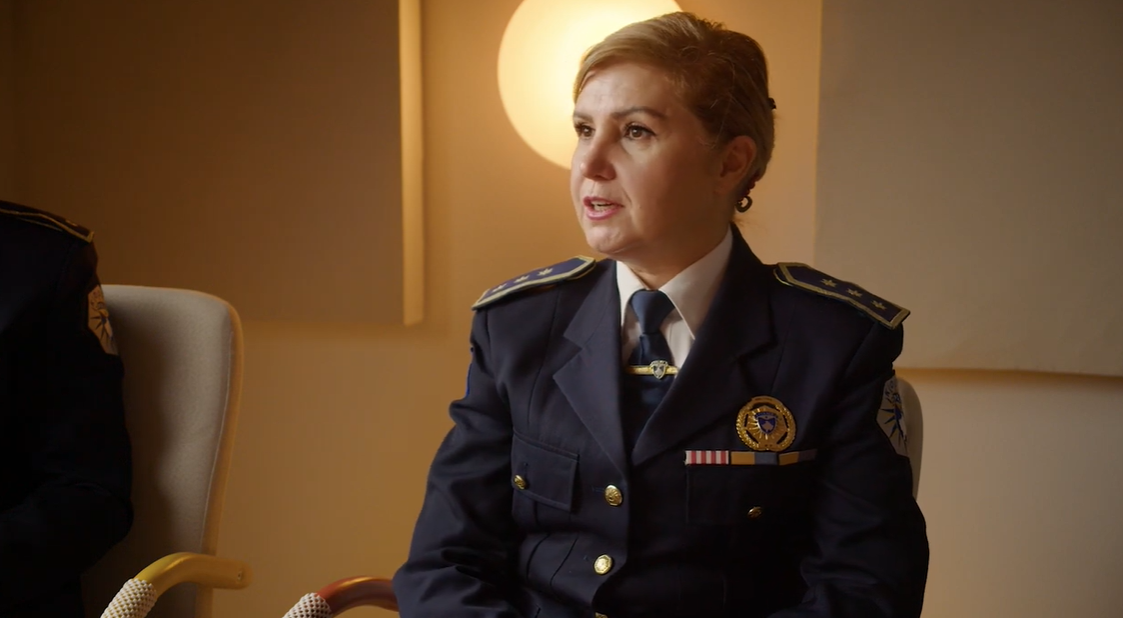

In a country that emerged from war and built every institution from scratch, being among the first few in the generation of security forces carries more than just a title, it carries the weight of responsibility and the awareness that history is watching. Manushaqe Nura carried that weight from the earliest days of the Kosovo Security Force (KSF), an institution that has since grown into one of the country’s most respected pillars.
With a career spanning 16 years of service in uniform, Nura stands among the few Kosovar women to have graduated from the Royal Military Academy Sandhurst in the United Kingdom — one of the world’s most prestigious military training institutions. Her achievement represents not only personal success but also dignified institutional representation. She has been awarded the Presidential Medal of Merit, one of Kosovo’s highest state honors, for her outstanding contribution to strengthening the KSF’s capacities and representing the country with professionalism and integrity on the international stage.
In a sector historically dominated by men, Nura helped ensure that the uniform came to represent strength as well as inclusion. She challenged stereotypes, advanced the gender equality agenda, and demonstrated that women are not just capable of being part of security structures — they are essential to their success.
Today, as the world confronts new and complex security challenges that require more inclusive approaches, the experiences of individuals like Manushaqe Nura are more relevant than ever. In this interview with the Institute for Women, Peace and Security, she shares thoughtful reflections from her career, the realities of being a woman in uniform, and her perspective on how Kosovo can move beyond policy papers to make the WPS agenda a lived reality.
________________________________________________
- You were part of the founding and consolidation of one of the newest security institutions in Europe – the KSF. In a context where the state was being built and institutions were still forming, what was it like for you to represent not only a new military generation but also a new vision for women’s inclusion in security?
For me, being part of the first generations of career officers and later contributing to the development of a new force like the KSF was an extraordinary responsibility and privilege. At a time when structures were still being built, we were fully aware that every step we took carried significant weight for the future. As a woman in uniform, I did not only represent a professional role but also a vision for broader inclusion of women in security. This was an opportunity to break stereotypes and create new examples that would influence future generations.
I must mention that, fortunately, in our country, the presence of women in combat formations within the KSF is not a completely new phenomenon, as our women have historically been actively involved in such roles. Thus, the KSF began building its structures on the right foot, offering access and responsibility to women across all formations, including frontline combat units. It’s worth emphasizing that, at that time, in many developed countries in Europe and beyond, the inclusion of women in all formations was still only a future ambition – and in many of them, it remains only an aspiration even today.
Women in the KSF, without exception and across all structures, have made an extraordinary contribution to the development of the Force. Wherever we have had the opportunity to represent Kosovo, both at home and abroad, we have excelled with competence, thus strengthening trust in the KSF among the public and international partners alike. Today, I’m very proud of what we’ve achieved — fully aware that it was the generations of women before us who broke the ice, but also very hopeful seeing the progress in younger generations.
- From your experience working with international partners, is there a specific model you would like to see implemented in Kosovo to strengthen the practical implementation of the WPS agenda?
Kosovo has taken significant steps toward implementing the Women, Peace, and Security (WPS) agenda by integrating it into key strategic documents, such as the National Security Strategy. Furthermore, elements of this agenda have been incorporated into national laws and institutional strategies within the security sector, reflecting the political will to advance gender equality.
In practice, there are positive developments worth noting, such as the establishment of women’s networks within security institutions, the appointment of gender equality officers in some leadership structures, and growing institutional awareness of the importance of this agenda. However, I believe this is not enough to guarantee deep and sustainable implementation.
To strengthen WPS implementation further, it is essential to expand the network of gender equality officers by including gender advisors not only at strategic levels but also at operational and tactical levels. These advisors should include not only civilian staff but also uniformed personnel so that their representation and impact are real and effective on the ground. This is a practice already successfully implemented in many NATO member states and has proven highly effective in creating an inclusive culture within security institutions.
Another crucial aspect is the active participation of men, particularly those in leadership and decision-making roles. In reality, decision-making within security structures is still male-dominated due to gender imbalance. Therefore, without their serious engagement, full and sincere implementation of this agenda is not possible. Gender equality is not just a women’s issue — it is about building a more fair and effective national security structure that requires full inclusivity.
- In your experience in defense and international cooperation, what have you identified as the most effective mechanisms for institutionalizing the WPS agenda at the state policy level?
From my experience in defense and international cooperation, I have found that the most effective mechanisms for institutionalizing the Women, Peace, and Security (WPS) agenda at the state policy level are those that combine clear objectives, measurable planning, and structured accountability.
First, security institutions must have mandatory goals for advancing women in the security sector, translated into concrete, measurable, and time-bound plans. For example, if the aim is to increase women’s representation in leadership positions, the institution must have a clear implementation plan, including:
- Specific quotas for recruitment and promotion of women;
- Targeted training for professional development and leadership;
- Regular mechanisms for monitoring progress and defined deadlines.
Second, this process must be accompanied by institutional accountability. Progress on gender objectives should be part of performance evaluations for leaders, directly influencing resource allocation and strategic decision-making — as practiced in the British, Canadian, and other armed forces. Regular reporting at the highest levels, including to the Government and Parliament, is also crucial. Leaders should report concretely on WPS implementation progress before the Security and Defense Committee, and at least one committee member should have a dedicated role for monitoring this agenda.
Third, it’s important that this agenda is seen as a domestic national need, not as an imposition from international partners. In the Kosovar context, women carry multiple responsibilities — they are active in the workforce and public institutions, while also bearing the primary burden of family duties. Not utilizing their potential in security is not only an issue of equality but a real loss for national capacity.
Combining these mechanisms — mandatory objectives, measurable plans, structured accountability, and sincere national commitment — forms the strongest foundation for the sustainable institutionalization of the WPS agenda.
- Kosovo is among the countries that has included the Women, Peace, and Security agenda in its strategic state documents. In your experience, what are the most common obstacles in turning policy into real-world implementation?
Often, the steps taken seem more like a response to demands from international partners than part of a conscious effort to build more just and inclusive institutions. In some cases, involvement in this area is viewed more as an opportunity for personal gain or public recognition than a sincere desire to advance the agenda.
Another ongoing obstacle is that many gender equality processes are implemented formally, without truly influencing the internal culture of institutions. In fact, there are cases where even women in leadership positions do not support this agenda, seeing its implementation as unnecessary favoritism rather than a tool to achieve real equality. That’s why I believe education about gender equality must begin much earlier — in the education system and in the early stages of civic formation.
This stance is not intended to diminish the value of the steps taken so far. On the contrary, regardless of the motivation or manner of implementation, it is far better that efforts have been made than if nothing had been done at all. As we say in the military: it’s better to have an imperfect plan on time than a perfect plan too late.
But now that we are at a stage where we must move forward, it’s necessary to be more self-critical, more sincere, and more results-oriented. Only then will future efforts around the WPS agenda move beyond words and lead to tangible changes in the lives of women and within our security structures.
________________________________________________
Thanks to the foundations built through years of hard work, dedication, and dignified representation by leaders like Ms. Manushaqe Nura, today’s generations have more opportunities than ever to forge their own paths in the field of security. The question is no longer whether women can be part of this sector, but how we ensure that the paths already opened lead to full and lasting inclusion. The example exists. The experience exists. And so does a real space for more women in leadership, in decision-making, and in every structure where security takes shape.
Through her experience and representation, Ms. Nura has contributed to shaping an institutional culture where women are seen not as exceptions, but as a natural and essential part of strength, knowledge, and strategic leadership. Even after concluding her service in the KSF, the impact she has left continues to resonate—in the paths she helped create and in the vision she has passed on to future generations.